

Sep 26
Safe Journey Home, Larry Prusak
I learned this morning that Larry Prusak had passed away over the weekend. I never had the good fortune to work closely with him, but considered him a friend, and my sense of loss is not just for myself but for the whole community of knowledge management practitioners that he inspired. He embodied in his work, his friendships, and his influence the generosity, the open-handedness and the honesty that I think characterises the best of our discipline. Dave Snowden has written a moving tribute, Nancy Dixon wrote a profile of him when he retired from teaching at Columbia, and Stan Garfield has a profile page worth visiting. My best memory of him is the conversation I had with Dave Snowden and Larry in Kuala Lumpur in 2008, on the topic “Is Knowledge Management Dead?”. Slán abhaile, Larry.
Oct 19
In the Dark
I’m going to India for a conference. As a European citizen, I’m fortunate. I can apply for an e-visa. Within the application process I need to upload a passport photo of specified dimensions and file size (this takes some fiddling around), and a PDF scan of my passport. This is where I get stuck. When I click to upload I keep getting an error message “only PDF files accepted”. I check - it’s a PDF. Perhaps the system doesn’t like PDF as images without text? I use the OCR tool and convert it to readable text. Still no luck. I check the file size. It’s within their stated requirement, but what the heck. I optimise the file size again. I read everything on the page and read everything on the FAQ page, and any other page related to e-visas. Nothing. Maybe I need to wait between attempts or there’s a system glitch? I go away intending to try again later.
Nov 18
Patrick’s Next Book to be Published by the MIT Press
We’re delighted that Patrick’s next book Principles of Knowledge Auditing: Foundations of Knowledge Management Implementation will be published by the MIT Press in late 2022. It’s a great honour to be working on this project with the MIT Press, which is one of the largest and most distinguished academic presses in the world. This book provides a clear theoretical and practical underpinning for the design and conduct of knowledge audits, disentangling a complex and confusing landscape of theory and practice. It will be followed by two more practice-oriented books: one on Knowledge Maps and one on Knowledge Audit Methods.
Sep 17
The Knowledge Manager’s Handbook Wins An Award!
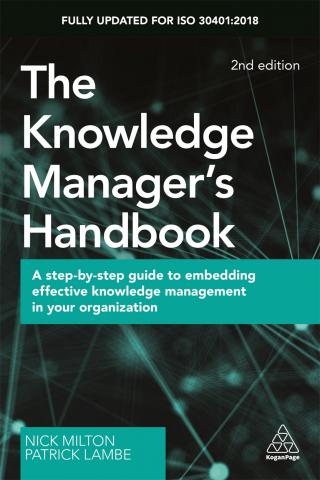
Well that was a nice piece of news for a Tuesday morning: my book with Nick Milton The Knowledge Manager’s Handbook has won CILIP UK’s prestigious K&IM Information Resources Award (in the print category) for 2019! This is great news just before the second edition of the book comes out – on 3rd October.
Also good news, friend and colleague Paul Corney has won CILIP’s 2019 K&IM Walford Award for his outstanding contribution in the field of Knowledge Management.
For those who are curious, the second edition of The Knowledge Manager’s Handbook involved a complete review and update of the first edition, with additional chapters on KM standards, the links between KM and digital transformation, AI and Big Data, and guidance on working externally and building professional capabilities. There are also new case studies from NASA, Public Works Department Malaysia, and PDO Oman. And if you want to get a special 20% discount, you can order directly from the Kogan Page website using the discount code FBM20 at checkout.
Aug 26
Why the concept of “valuing” knowledge and information can be misleading
Here’s a short piece I wrote for Real KM Magazine on the issues with using the metaphor of “value” for knowledge and information. With thanks to Stephen Bounds for his editorial inputs.
Mar 20
Talk and Resources on Knowledge Auditing
Thanks to Stan Garfield for putting together this SIKM Leaders call yesterday and all the supporting links and resources. Follow the link for the slides, the audio recording, and some helpful background links. Visit the post here.
Oct 05
Knowledge Manager Lifespans Getting Longer?
In 2008 I ran a global survey on knowledge manager professional development and experience. It found that only 29% of knowledge managers had been in their role for more than 4 years, and only 25% were confident of moving on to another KM role. The average “lifespan” among respondents was something like 2.5 years.
Nick Milton recently surveyed his KM contacts on LinkedIn and found that knowledge managers average lifespan seems to last about 6 years – which shows progress! About 60% will survive beyond 4 years, double my figure a decade ago. However, only about 25% of his subjects are likely to have had a longish (8+ years) career in KM. Progress, but slow progress!
Aug 03
Synaptica’s Vivs Long-Ferguson Interviews Patrick Lambe
Jul 26
Method Knowledge
One of the knowledge types we take pains to highlight during a knowledge mapping exercise is method knowledge - the type of knowledge that a team builds up over time and that which makes them effective. It is knowledge that is seldom captured because people are either unaware of how valuable that knowledge is, or they do not see capturing it as a priority.
Apr 20
Taxonomy and Search Patterns for Search and Discovery

So you have built and implemented a taxonomy but search is still not returning the desired results. What do you do?
Taxonomy alone is limited in what it can do. Search alone is also limited. Together, they become much smarter. If taxonomy and search are integrated, they can be very powerful and vastly improve the user experience.
In this article, inspired by the work of Callender, Morville and Nichani (see references in the paper) Patrick outlines 10 search patterns that taxonomy and metadata can support. He lists their benefits, dependencies, potential applications, and illustrates them with real life examples.

